
The Workers Are Here!
Growing up with the most honored guests in the 2x2 church

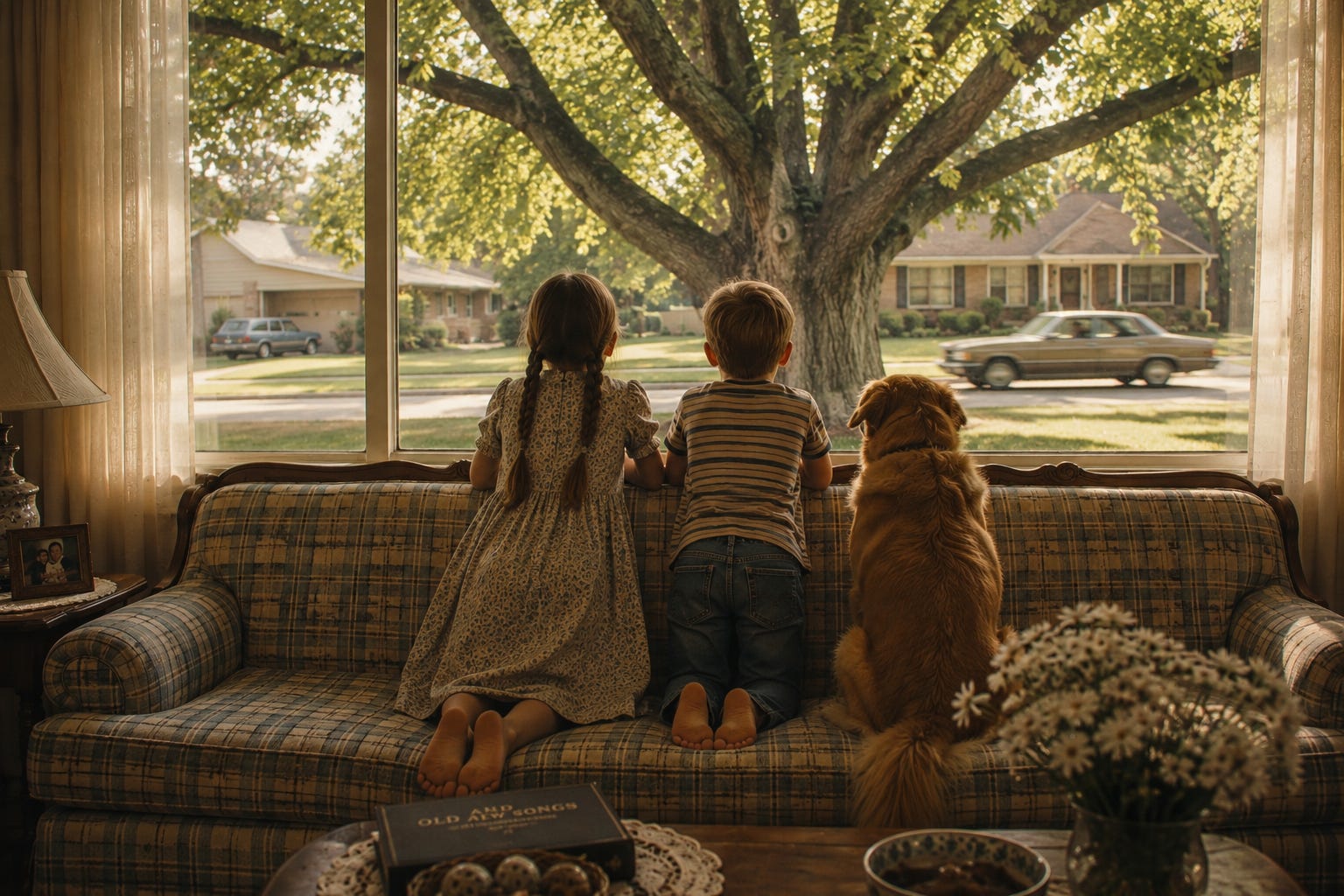
Resting on my knees, I leaned against the back cushion of the cream and baby blue plaid couch, peering over the wooden adornment on the top edge of the sofa to watch the traffic go by.
The street was always busy, with the occasional emergency vehicle speeding by, lights on, and siren screaming at all hours of the day and night. But usually, the constant traffic added a calming sound to the home environment, similar to the gentle rush of waves crashing on the shore, except with a loud engine or the honk of a horn interrupting the cadence every now and again.
A giant sycamore tree stood in the very center of the front lawn, a place it had claimed since the 1950s when the tan-brick home with dark brown trim was originally built. The large limbs full of verdant leaves reached across the entire yard, shading the house and the landscape. Its helicopter seeds would float lazily to the ground in the spring months.
My little brother and I often took up this position on the couch in front of the large picture window to watch for expected guests. Usually, our reddish-gold-haired rescue dog would join us, mostly just for the cuddles, but his ferocious bark at the sight of a car pulling onto our black-top driveway would give us a jump scare, even if we expected it.
“Mom! The workers are here,” I yelled, excitement filling my voice. But at the thought of greeting these ministers, whom I really didn’t know, I began feeling shy and unsure of myself, simultaneously wanting to hide and run to greet them.
Our mother had prepared us for these special guests well ahead of time, asking us to clean our rooms as if we were preparing them for Jesus to stay. At first, I’d try shoving everything under my bed or in the closet, which my mom would quickly identify and tell me to start over. It was a job I hated, knowing that my room would never quite look good enough.
Usually, the only guests we had were workers (ministers) from the fundamental Christian church we attended, referred to as the Truth by members, and the 2x2 church by ex-members. We almost always had women workers, and when they visited, they’d stay for a few nights, taking my siblings’ and my bedrooms while we slept on the living room floor or couch in sleeping bags. They’d arrive with a suitcase and several bags filled to the brim, sometimes with typewriters, sewing machines, or other hobbies.
I always expected them to be as happy to see me as I was excited to see them, but they weren’t. They’d walk into the house, slip off their dress shoes, their feet still covered in nylons, and hurry off to their rooms. I imagined they were straightening their hair, making sure their buns and updos were immaculate by suppertime. Maybe they’d iron their dresses to ensure no wrinkles. Or maybe they were reading their Bibles and praying. Most of the time, they kept their doors closed, which only increased my curiosity.
The delicious aroma of a home-cooked meal filled the air. They almost always arrived at suppertime, and my mom worked hurriedly on a schedule to ensure the food hit the table shortly after they arrived. It was my job to set the table with plates, silverware, and napkins, and fill the water glasses.
When supper was ready, and my stomach was growling so much I imagined I’d starve, I could finally knock on the workers’ bedroom doors to tell them it was time to eat. They’d reply with a “thank you, I’ll be right out.”
We all had assigned spots at the dining table, but when the workers were visiting, one would take a seat at the head of the table, opposite my dad, while the other sat next to them on one side. We kids were rearranged where it was most convenient for my mom and dad to keep an eye on us and ensure we behaved.
We crowded around the table, and all grew silent, as was custom. My dad asked the elder of the two workers to pray for the meal. Their prayers for the meals were often a lot longer than what we were used to, and we might sneak a peek around the table as we waited for them to finish up so we could eat the food set before us.
The workers were always served first, and usually requested about half a portion size of whatever was on the table. They ate slowly and methodically, often setting their forks down on the table as they conversed with my parents. Sometimes they would ask us kids questions, especially if one of the workers was young.
When the meal was over, we often were treated to dessert, which wasn’t the norm in our household. Money was tight, and we knew that a treat after supper meant it was a special occasion—usually reserved for birthdays.
And then came the waiting.
We had to sit still at the table until the conversations were finally over. Our backs, legs, and bottoms would grow tired of sitting, and we’d begin to stir—earning a meaningful glance from our parents, or a quiet whisper to knock it off. In those days, the conversations were often about the Bible. Sometimes we would read a chapter together, going around the table as each of us read two verses on our turn. As the years went on, conversations became less about the Bible and more about who knew so and so, and how they were related, or other social-related topics.
Finally, someone would say, “Well, we could move to the living room and be a little more comfortable,” and everyone would get up from the table. My dad and brothers would head to the living room, while my sister and I helped my mom clear the table and either wash dishes or load the dishwasher. The sister workers generally helped with these tasks, but the brothers would join the other males in the living room, reading the newspaper or chatting about dad’s work.
It never seemed fair to me that I had to clear the table when my brothers could just leave. And I always whined about it, as I was prone to do as a child, which would result in another pointed look from my mother.
I was notorious for getting a little too silly after a while. I loved to laugh and try to make everyone around me laugh too, smiling from ear to ear, and just being “too much.” At first it was tolerated, but when the workers began showing signs of annoyance, I would be gently told it was time to settle down. We must be on our best behavior when the workers were around.
We always hoped that the workers visiting would love to play games, and occasionally they did. The grumpy old women loved to play Scrabble and were weirdly competitive about it, but the more fun ones would let us choose the games—sometimes Life, Monopoly, or Yahtzee.
It was common for one of the workers or my mom to sit down at the piano and play hymns from the Old and New Book. Sometimes they would ask us to sing along, something I always felt embarrassed doing. They’d ask us kids what our favorite hymns were, and I wouldn’t have an answer—feeling ashamed that I didn’t have one.
The days would pass by in similar fashion. The sister workers might spend some time in the living room working on their cross-stitch or knitting projects. Mostly, they would disappear into their rooms for hours on end, only to reappear to leave the house on a long walk around the neighborhood.
The evenings would pass the same—waiting for Dad to get home so we would eat together. I would set the table, knocking on the workers’ doors to let them know it was time to eat, and then suffering through more chair sitting as the adults talked.
By the time they left, lugging their suitcases and a variety of bags back to the trunk of their car, I think we were all relieved they were moving on. Finally, we could breathe again. We could be ourselves again, and play outside after supper rather than sitting for what seemed like hours at the table.
No more dessert, but we got our rooms back, and sleeping in our own beds again was the best part. If we were lucky, a young sister worker would have left us a small note of thanks on our pillows. But that was rare.
And then we could breathe a sigh of relief that we’d probably have at least a few more weeks before another visit where we would repeat it all over again.
Looking back, what strikes me most isn’t that I disliked the workers—I didn’t. I longed for their approval. I wanted their love and acceptance. I wanted them to see me as special as I saw them.
But they didn’t. I never felt that, and it only got worse the older and more awkward I got.
Their presence changed our home, though. A home that was normally relaxed and full of laughter became stressed and tense. We were lucky if a younger worker was visiting, who hadn’t had their vitality kicked out of them yet.
What strikes me is that these guests called themselves servants, and yet we were the ones who served them. Everything changed when they came. We ate differently. We surrendered our bedrooms. They were given the best seats and served first. We watched our behavior more carefully. Even my natural tendency as a child to laugh too loudly and be a little too silly had to be reined in, until eventually it was snuffed out.
We had to act as if we were the perfect professing family, and we were a fine family on ordinary days, but we had to up our game when the workers visited. If we didn’t, we could feel the judgment radiating throughout the room. At least to me, there was a sense that who we were was not quite good enough.
And that’s sad.
It’s strange to think about that little girl kneeling backward on the 90s-era plaid couch, peering through the picture window and waiting impatiently for the workers’ car to appear. She was genuinely excited to see them.
But a few days later, she was just as happy to watch that car pull out of the driveway.
Maybe even happier.
Because, finally, we could be who we were every other day of the year. No acting. No putting a cap on our personalities. No worrying whether we were sitting still enough, behaving well enough, or looking enough like the professing family we were supposed to be.
We could just be us.
We were already an imperfect, ordinary, loving family. And that should have been enough.
Wow... I lived on both sides of this. I remember feeling very meh about worker visits growing up. As a worker I was often trying really hard to not be meh because of those memories. This really captures how the constraints of the system were usually too much to overcome. Even the ones trying to be different could leave people feeling less than in their wake.
Wow, so relatable!😌